Has anyone had any experience on this crowdsourced translation project?
In today's world of constant connectivity, we are bombarded with an
overload of messages, information, and content on our computers, mobile
phones, and various other devices.
The plethora of information, in many cases, is not relevant to us.
The most relevant content, on the other hand, is sometimes not
searchable, and therefore, it is difficult to access what we really want
to see.
Related:
- Crowdsourced Translation Service Gengo Raises $12M
- Let's Translate the World's Videos, Starting With This One
Take for example, when we type in a search for “best of French wine.”
We get thousands of relevant results, but in reality, the most
pertinent answer is often not at the forefront of our search for one
simple reason – language barriers. The results we see and the way we
search the web is limited by language parameters, so if it is not
written in our native language, it may not materialize on our search
results. And even if it did, we would not been able to understand it,
unless we were fluent in that language.
Subsequently, the article on French wines written by a local French
connoisseur that would have been the perfect find may remain
inaccessible. When we search on Google, the search engine automatically
detects our IP address and brings us to the local Google page, unless we
manually override the language settings. This is true of many other
sites as well. The results we get are only in the default language
selected. Content that is more relevant to our search is “hidden”
because it is written in a different language. In a perfect world, we
could get search results from anywhere from around the world, translated
to your native language.
A few companies crowdsource volunteer multilinguals from all over the
world to make content accessible through translation. These volunteers
help break the language barrier. Some do it because they are passionate
about a specific subject. Some do it because they are passionate about
translating. Many do it to help level the playing field and make
information accessible to all. We’ve seen this happen successfully with
Wikipedia, where its crowdsourced translation model continues to
flourish, with over 280 language editions made available through their
volunteers.
Source: here
Friday, May 31, 2013


Saturday, August 11, 2012
Google Translate can now handle images of text
Google has released yet another update for its official Translate app for the Android devices.
Google has released yet another update for its official Translate app for the Android devices. The new update for the Google Translate brings image translation to the Android platform. Besides that, the app also brings instant translation of words as you type. With support for more Asian languages, the new Google Translate is one of the must have applications when you are travelling to any new place.Google Translate helps one translate words and phrases of the language they do not know to their own language. The app offers text to speech and speech to text options to enable a conversation between people speaking two different languages.
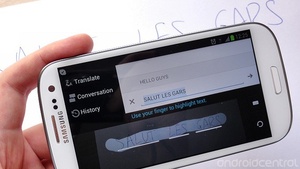
The image reading feature will work with all languages that are available via Translate and allow users to highlight relevant text from the photo for conversion.
Using the app on your phone will allow you to take a picture, then swipe gestures to highlight the text needed to be translated. The cropped image is then sent to Google's servers where it is sent back translated.
The only catch is that you must select the language, since Google cannot auto-detect it.
Sources: indianmobile, afterdawn
Wednesday, July 18, 2012
My Video Intro to TRADOS
TRADOS is a prerequisite for professional translators. If you want to know a little about this, I have created this video on youtube.
Friday, July 6, 2012
PEN Translation Fund Grant Winners Announced
The PEN Translation Fund, now in its ninth year, has
announced the winners of this year’s PEN
American Center
Translation Fund Grants. “From a field of 130 applicants, the Fund’s Advisory
Board—Susan Bernofsky, Barbara Epler, Edwin Frank, Michael Reynolds, Richard
Sieburth, Eliot Weinberger, and Natasha Wimmer, and chaired by Michael F. Moore—has
selected…twelve projects for funding.” Below are brief summaries of the
projects.

from “Thirty Eggs”
Alexander Booth for Im Felderlatein (In Latin Fields) by Lutz Seiler. Widely acknowledged as one of the major German poets of his generation, the work of Seiler has been translated only sporadically. Booth’s translations give a strong sense of Seiler’s poetic voice, with an incessant use of fragmentation as he attempts to pin down memory (usually childhood memory, sometimes of traumatic events) and the stark imagery of his terse lines. (Available for publication)
Brent Edwards for L’Afrique fantome (Phantom Africa) by Michel Leiris. A diaristic account of Leiris’s activities as the “secretary-archivist” of Marcel Griaule’s Mission Dakar-Djibouti (1931-33), often compared to Lévi-Strauss’s Tristes Tropiques for introducing a path-breaking critical self-reflexivity into the discourse of anthropology. (Seagull Books)
Kraus. These translations display an explosive inventiveness and poetic intelligence that find surprising, engaging ways to render Kraus’s poems. They appeal as much through their sly punning and syncopated rhythms as they do through the stories told between the lines. (Available for publication)
Musharraf Ali Farooqi for his translation from the Urdu of Muhammad Husain Jah and Ahmed Husain Qamar’s Hoshruba: The Prisoner of Batin, the second volume of an 8,000-page late-nineteenth century epic of magical fantasy based on the popular oral narrative tradition. (Random House India)
from “Sorceress Nafarman”
Deborah Garfinkle for her translation of Worm-Eaten Time: Poems from a Life Under Normalization, a selection of hallucinatory poems that were banned by the government and circulated in samizdat copies, by the Czech poet Pavel Šrut. Šrut’s poems were written during the Prague Spring of 1968 and then, after a ten-year silence, in the 1980s before the fall of Communism. (Available for publication) from “Worm-Eaten Light”
Hillary Gulley for the translation of Marcelo Cohen’s El fin de lo mismo (The End of the Same). A formal experimentation and sci-fi-inflected mini-plots—including a prison on the beach and a man in love with a woman with three arms—shape this finely wrought Argentinean novel. (Available for publication) There are men on the beach. They are prisoners. Right now they are establishing a routine in order to accommodate various states of rage, depression, and reverie. Most of them have been unsuccessful. . . It seems as though some of them have already met before prison, or maybe they are just drawn to each other by their rancorous affinities; now some of them lounge in the shade of the canopies on the beach, others sit on the parapet between the sand and the asphalt, others keep their distance, lying at the water’s edge, and still there are others who do not leave their cells, perhaps because they have never seen the sea and are more skeptical than curious.
Bonnie Huie for her translation of Notes of a Crocodile by the Taiwanese writer Qiu Miaojin. The only novel published by Qiu before her suicide at 26, this work is an extraordinary combination of mash note, love story, comic shtick, aesthetic manifesto, and spiritual autobiography. It is a groundbreaking queer novel and a classic of modern Taiwanese literature. (Available for publication)
from “Notebook #1″
Jacquelyn Pope for her translation of Hester Knibbe’s Hungerpots, from the Dutch. These wry, unsentimental poems gently upend myths of domestic life and wax anti-poetically (yet beautifully) on the most ordinary manifestations of nature. (Available for publication)
Matt Reeck and Aftab Ahmad for a delightfully light-on-its-feet translation of the novel in Urdu Mirages of the Mind by Mushtaq Ahmad Yousufi. Tracing an arc of nostalgia between Pakistan and India, its main characters are all Indian Muslim immigrants in Pakistan whose struggles veer from the comic to the tragic. The translators’ touch is graceful, lively, and supple. (Available for publication)
Carrie Reed for a complete translation of Youyang zazu (Miscellaneous Morsels from Youyang) by Duan Chengshi. A vast compendium from the Tang Dynasty of weird scientific and ethnographic information and generally strange stories. (Available for publication)
Nathanaël for The Mausoleum of Lovers by Hervé Guibert, a posthumous collection of the private journals that the well-known novelist and AIDS activist kept from 1976-1991—a series of literary snapshots of the author’s various objects of desire and mourning and already a classic of French autobiography. (Nightboat Books)
The Advisory Board is also pleased to announce that its nominee for a 2012 New York State Council on the Arts translation grant, Ana Božičević, was awarded a grant in January for her translation of It Was Easy to Set the Snow on Fire by Serbian poet Zvonko Karanović. Karanović, a countercultural icon, writes in a vivid, sophisticated vernacular of desire and transcendence amid cultural and political change. (Available for publication)
Publishers and editors who wish to express an interest in any of these projects are invited to contact Paul Morris (paul at pen dot org ) or Michael Moore (michael dot moore at esteri dot it).
The Fund gratefully acknowledges the ongoing support of Amazon.com, which has assisted the Fund’s work this year with a gift of $25,000.
From poetryfoundation and pen.org
Monday, June 25, 2012
Visual Frames Releases TraductoPro 1.0.2
| From Melodika.Net |

|

|

|
| Sunday, 24 June 2012 | |
|
Visual Frames today announced the release of TraductoPro version
1.0.2, a powerful and easy to use content translation application and
localization tool for iOS and Mac app developers. The TraductoPro
localization tool supports three types of projects: Document
Translation, App Store Information, and Xcode iOS or Mac app
Localization. With the iOS and Mac user base spread throughout the world, localizing apps greatly expands app developers’ ability to increase sales and improve the user experience by supporting apps in the users’ native language. The TraductoPro application for Mac makes it simple for developers to localize their Xcode based applications. Marketers and app developers can get 16 different language translations for their documents and manage their App Store information projects as well. For app developers, you can import existing content or start from nothing using TraductoPro. The application allows developers to create and organize content, translate the content, keep track of the changes and add new sections to the project. TraductoPro for Mac makes it simple to translate content and share it with a wider global audience. Traducto translation service is fast, certified and powered by professional translators. TraductoPro’s translation allows you to translate large amounts of content through a simple app ordering process, easy checkout with major credit card or paypal and speedy delivery. TraductoPro provides four choices for content translation: Manual: You manually provide your own translation, using TraductoPro to manage the project. Standard: A native speaker translates the content. Professional: Translation is performed by degreed professional. Enterprise: Translation is performed by a degreed professional with a second professional proofreading (2 unique reviewers). What is new in TraductoPro 1.0.2? Features *Add support for Xcode import/export of localizable .html and .htm files. *Project dashboard’s Add to Cart button now toggles to Remove from Cart functionality. *Added a view (eye) button to projects in the Cart view allowing navigation back to a project’s dashboard. *Updated Google Plus link. Bug fixes: *Save in address book on Checkout view now works. *Now hyphens and full-stop/periods are allowed in phone and fax numbers in the Checkout view. *Multi-line text in translations now handled properly. *Minor translations text parsing improvements. *Fixed bug where Interface Builder strings comments were not always being parsed correctly. *Black polling window now fixed. *Fixed language word count infinite loop when visiting cart. *Addressed a number of crashes due to incorrect memory reference counting. *More robust handling of source language data attachment failures. Availability TraductoPro 1.0.2 is available now, and may be downloaded through our Web site at http://www.traductoapp.com/traductopro/. |
Sunday, June 24, 2012
Google Translate Has Improved Its Tool: What Do You Think?
In a further attempt to sharpen the tool, Google has recently
introduced a new Plugin which allows the user to suggest translation
which the web site owners can directly assimilate on their website. In
the words of Jeff Chin Google’s Translates Product Manager, as mentioned
in a blog post “Once you add the customization Meta tag to a webpage,
visitors will see your customized translations whenever they translate
the page, even when they use the translation feature in Chrome and
Google Toolbar. They’ll also now be able to ‘suggest a better
translation’ when they notice a translation that’s not quite right, and
later you can accept and use that suggestion on your site.”
“If you’re signed in, the corrections made on your site will go live right away — the next time a visitor translates a page on your website, they’ll see your correction,” says Chin. “If one of your visitors contributes a better translation, the suggestion will wait until you approve it. You can also invite other editors to make corrections and add translation glossary entries.”
The key features of the new tool are as follows:
This step of Google has brought forth a revelation that even the search engine giant has Achilles heals. It is beyond the comprehension of the artificial intelligence to reach in depth of the lingual intricacies for perfect translation. Yet even a single step in the direction of enhancing the online translation process is respectable as it is the small efforts only which create big changes.
Extracted from http://www.prsafe.com/new_press_releases/view/9407
“If you’re signed in, the corrections made on your site will go live right away — the next time a visitor translates a page on your website, they’ll see your correction,” says Chin. “If one of your visitors contributes a better translation, the suggestion will wait until you approve it. You can also invite other editors to make corrections and add translation glossary entries.”
The key features of the new tool are as follows:
- Instantly translate your site content into 60+ languages by means of Google's Translate
- Customize and enrich the translation of your website
- Collect and incorporate translation suggestions from your users
- Invite other editors to manage translations and suggestions
This step of Google has brought forth a revelation that even the search engine giant has Achilles heals. It is beyond the comprehension of the artificial intelligence to reach in depth of the lingual intricacies for perfect translation. Yet even a single step in the direction of enhancing the online translation process is respectable as it is the small efforts only which create big changes.
Extracted from http://www.prsafe.com/new_press_releases/view/9407
Subscribe to:
Posts (Atom)